
Black Dollars Under Pressure: Houston’s Contracting Fight Is About Economic Power

A public contract can change the future of a business. It can fund payroll, create jobs, support expansion, and give an entrepreneur something to pass down.
That is why Houston’s legal fight over minority contracting deserves attention far beyond City Hall. For Black business owners, the stakes include access to the public dollars their own communities help generate.
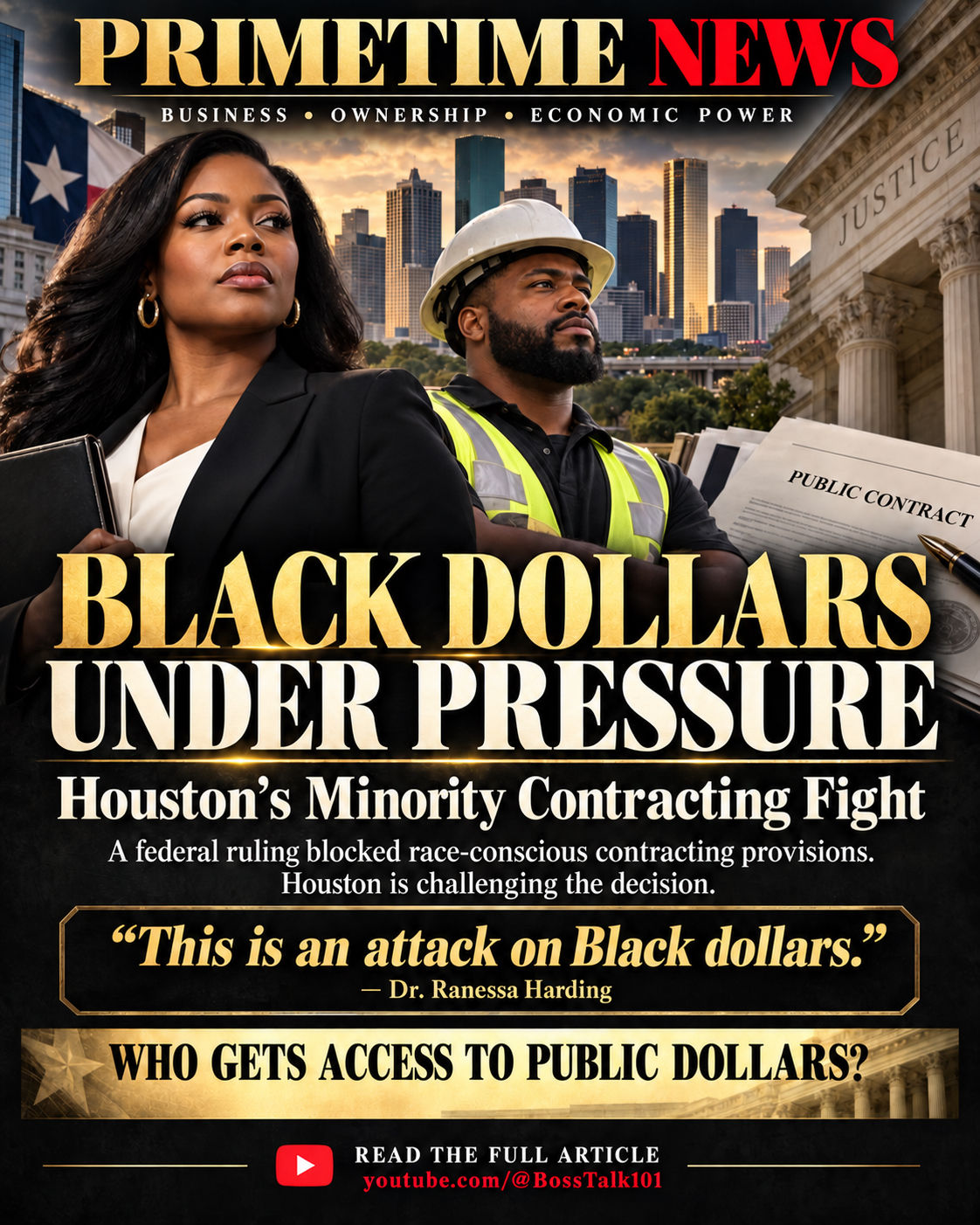
On July 28, 2026, U.S. District Judge David Hittner blocked the race-conscious portions of Houston’s Minority, Women, and Small Business Enterprise program, finding they violated the Fourteenth Amendment’s Equal Protection Clause. The order also reached the racial provisions of the Midtown Management District’s contracting policy. It did not prohibit Black-owned businesses from bidding for public work. It removed a mechanism intended to expand their participation.
Houston is fighting the decision. In an August 17 filing, the city asked Hittner to reconsider, arguing that its disparity evidence justified the program. That distinction matters: asking the trial judge to alter his judgment is a specific legal step, and should not automatically be described as an appeal already pending before a higher court.
For Dr. Ranessa Harding, the concern is direct: “This is an attack on Black dollars.”
That statement expresses a broader economic concern: what happens when government removes a tool for addressing exclusion without demonstrating that the underlying barriers have disappeared?
Supporters of the ruling argue that public contracting must treat businesses equally regardless of race. The court concluded Houston had not established the specific discrimination necessary to justify its racial classifications. Houston disputes that conclusion, pointing to evidence of minority business underutilization. Those competing positions sit at the center of this fight.
But the policy question reaches beyond the courtroom: Does removing race from the rules remove racial barriers from the marketplace?
An open application does not automatically provide access to financing, bonding, established subcontracting relationships, or the cash reserves needed to complete work while waiting for payment. Procurement systems must examine those barriers if equal opportunity is going to mean anything in practice.
The consequences can extend well beyond the business owner. When a firm loses access to a potential contract, the opportunity at stake may include employee wages, supplier purchases, neighborhood investment, and future ownership.
This is why the reference to Black Wall Street carries weight.
Houston’s contracting dispute is not equivalent to the 1921 Tulsa Race Massacre, when racist violence devastated Greenwood and took lives. That history deserves precision. The connection is the concern over Black economic independence: the ability to build businesses, retain wealth, employ our communities, and transfer assets across generations.
Different circumstances can still raise a familiar question: how secure is Black prosperity when the pathways supporting it can be dismantled?
For entrepreneurs, the immediate response must combine advocacy with execution. Houston has said its separate Small Business Enterprise program is unaffected by the ruling. Eligible firms should verify current requirements, monitor individual solicitations, strengthen their bid packages, and pursue prime and subcontracting relationships. A certification should support a business development strategy; it cannot carry that strategy alone.
Meanwhile, public officials should be pressed for measurable answers. Will smaller firms receive meaningful opportunities? Will contracts be structured so emerging businesses can compete? Will agencies track who wins, who gets paid, and who remains excluded?
Black entrepreneurs should not have to keep proving that their participation has public value. They create jobs, deliver services, pay taxes, and build institutions.
The question is whether public contracting will recognize that value with real access—and whether “equal opportunity” will be measured by outcomes as seriously as it is defended in court.
Recent posts
See all Dr Ranessa Harding•Oct 24, 2026•1 min read
Ryan Coogler’s ‘The X-Files’ Gets Hulu Series Order—and a New Perspective
Ryan Coogler is opening the door to another world of mystery. Hulu has officially ordered his reimagining of The X-Files to series, with Danielle Deadwyler and Himesh Patel leading the cast. The story follows two accomplished FBI agents whose different approaches collide when they are assigned to a previously shuttered division investigating unexplained phenomena. Coogler wrote and directed the pilot and will executive produce alongside showrunner Jennifer Yale and other collaborators. The...

 DJ Bobby Eupho•Oct 24, 2026•2 min read
JAY-Z & SCARFACE REUNITE FOR A MOMENT HIP-HOP WON’T FORGET
More than 25 years after “This Can’t Be Life” first hit, Jay-Z and Scarface brought its history back to life at SoFi Stadium. During the October 23 stop of Jay-Z’s 30 celebration, the Houston legend joined Jay-Z on stage for the 2000 The Dynasty: Roc La Familia track, then delivered the Geto Boys classic “Mind Playing Tricks on Me.” But this was bigger than a surprise guest appearance. It was a full-circle moment tied to one of hip-hop’s most emotionally honest verses. Jay-Z revisited the...
 DJ Bobby Eupho•Oct 23, 2026•2 min read
BOSSTALK 101 REVIEWS BREAKS DOWN FUNKMASTER FLEX’S KNICKS GAME ALTERCATION IN TWO-PART DISCUSSION
Bosstalk 101 Review Click For Full YouTube Review Bosstalk 101 Reviews takes viewers through a two-part conversation sparked by viral footage of a heated altercation involving Funkmaster Flex at Madison Square Garden during the New York Knicks’ season opener on October 20. In Part 1, E CEO brings Dre From Around The Way onto the show by phone to discuss the incident and the reactions surrounding it. Defending the East Coast perspective with a joking jab, Dre says that while people in the...
Comments
Loading comments…